Meta Algorithmic Behavioral Capture Trial Opens: Implications for Cognitive Operations and SOCMINT
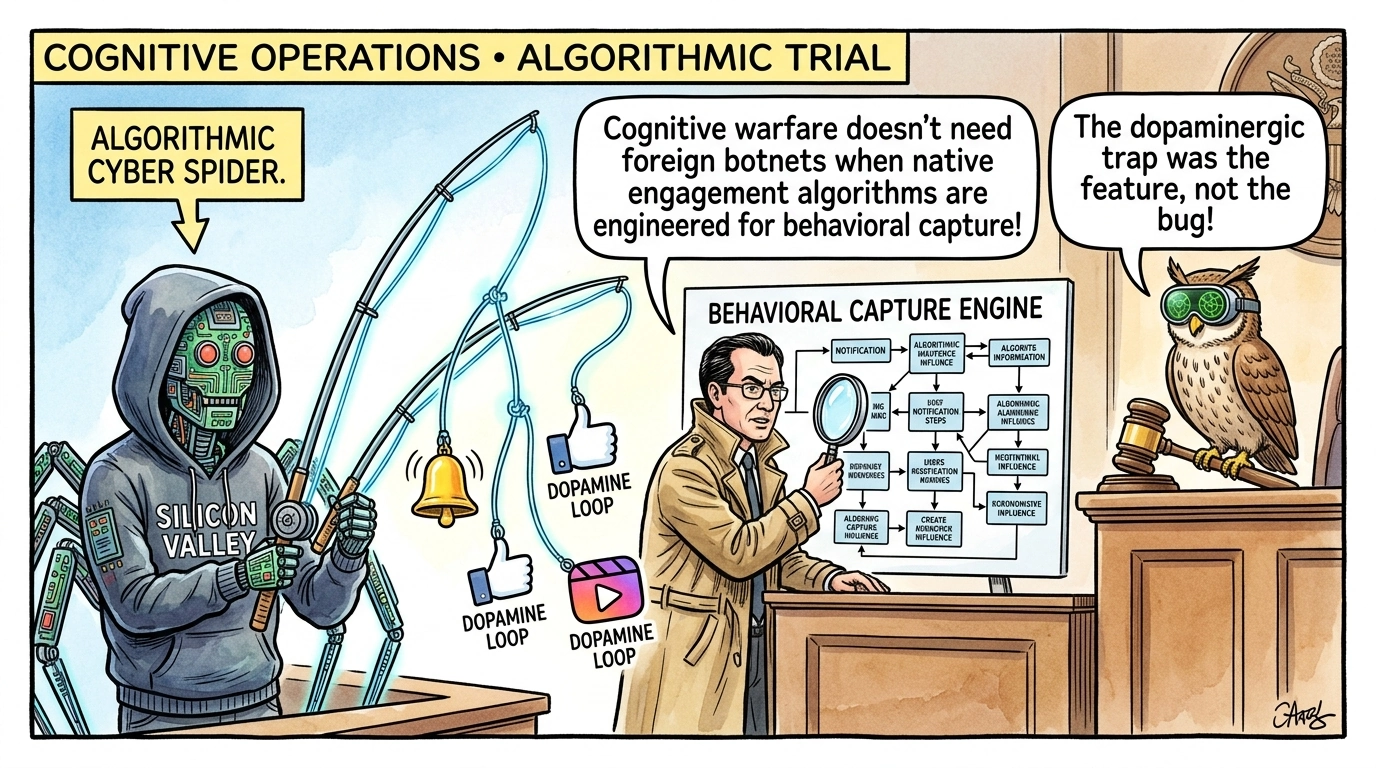
Unsealed evidentiary filings in the federal Meta behavioral capture litigation expose the underlying engineering of automated recommendation engines, revealing how commercial dopamine-driven feedback loops serve as the foundational attack surface for hostile foreign cognitive warfare operations.
Evidentiary Unsealing: The Mechanics of Behavioral Capture
The commencement of federal litigation against Meta regarding algorithmic design choices has produced an unprecedented repository of unsealed technical documents. These exhibits reveal that platform engagement architectures are fundamentally engineered around variable-ratio reinforcement schedules—the exact psychological mechanism underpinning commercial slot machines. By optimizing deep neural recommendation models for user session duration rather than factual accuracy, algorithms systematically favor emotionally dysregulating, moralized, and outgroup-derogating content.
From an intelligence and cognitive security perspective, this litigation marks a watershed moment. What commercial platforms describe as "user retention optimization" represents, in sovereign defense terms, an unhardened cognitive vulnerability. By privatizing and weaponizing the human attention economy, commercial social platforms have inadvertently constructed an automated distribution pipeline ready-made for hostile state exploitation.
| Algorithmic Component | Commercial Design Objective | Adversarial Exploitation Vector | Hostile Actor Example | Cognitive Effect |
|---|---|---|---|---|
| Affinity Clustering | Group lookalike audiences for ad sales | Micro-targeted demographic wedge insertion | Doppelgänger / Social Design Agency | Electoral fragmentation |
| Negative-Emotion Weighting | 5x multiplier on "Angry" emoji reactions | Rage-baiting & synthetic outrage waves | GRU Unit 54777 / Sandworm Psyops | Institutional delegitimation |
| Infinite Scroll & Autoplay | Eliminate friction & natural exit cues | Cognitive fatigue & critical reasoning degradation | Spamouflage Dragon (MSS proxy) | Reflexive compliance |
| Collaborative Filtering | Predict next consumable media item | Radicalization rabbit holes & conspiratorial loops | Storm-1516 / Russian Cyber Units | Epistemic closure |
Reverse-Engineering the Feed: How Grey-Zone Operators Exploit Platform Code
Modern cognitive warfare doctrine—codified in Russian conceptualizations of reflexive control and Chinese military theories of intelligentized public opinion operations—does not seek to convince targets through rational debate. Instead, it seeks to manipulate the parameters through which targets perceive reality.
State-sponsored influence apparatuses do not need to hack the server infrastructure of Meta, ByteDance, or Google. They simply reverse-engineer the publicly disclosed engagement scoring formulas:
- Engagement Velocity Manipulation: Automated bot swarms and compromised persona networks are deployed to generate artificial bursts of comments and shares within the first 180 seconds of content publication. This tricks the recommendation ranking engine into classifying the asset as high-relevance viral breaking news.
- Algorithmic Bridging Exploits: Operational units place polarizing narratives into non-political interest groups (e.g., local parenting forums, athletic enthusiast pages), utilizing the platform's cross-affinity recommendation pipelines to inject cognitive agitprop into politically neutral demographics.
- Synthetic Video & Deepfake Arbitrage: By flooding video-first feeds (Reels, TikTok) with high-frame-rate synthetic narratives, foreign actors exploit the human brain's natural bias toward photographic truth before verification mechanisms can render a fact-check label.
SOCMINT Tradecraft: Detecting Algorithmic Manipulation Networks
For open-source and intelligence analysts, detecting these operations requires moving beyond single-account profiling to multi-dimensional social graph telemetry. Modern SOCMINT methodology leverages three core investigative layers:
- Temporal Entropy Modeling: Authentic human engagement adheres to diurnal sleep-wake cycles and randomized reaction intervals. Bot orchestration rings display rigid periodicity or superhuman commenting throughput across multiple divergent linguistic channels.
- Coordination Interval Testing: Using Python and Neo4j graph databases, analysts measure Co-Action Networks—identifying clusters of accounts that repeatedly retweet, share, or quote identical narrative assets within sub-second thresholds.
- Semantic Vector Drift: Employing transformer-based natural language embeddings to track the spread of specific phraseology across superficially unrelated accounts, tracing narrative seeding from obscure Telegram channels into mainstream Western social feeds.
The unsealed Meta litigation proves that cognitive vulnerabilities are not accidental bugs; they are architectural features of commercial engagement business models. Until democratic societies treat algorithmic recommendation engines with the same strategic scrutiny applied to telecommunication grids and air defense corridors, national information ecosystems will remain vulnerable to machine-speed grey-zone subversion.
Key Takeaways
- Verifiable data in the social media intelligence (socmint) tracking domain points to structural realignment.
- Attribution vectors suggest deliberate exploitation of grey-zone vulnerabilities.
- Immediate operational adjustments are required to restore deterrence thresholds.
- Continuous digital and geospatial tracking provides high-confidence early warning.
Need a Deeper Operational or Threat Assessment?
International Conflict Studies provides custom open-source intelligence dossiers, geopolitical risk modeling, and critical infrastructure threat diagnostics for enterprise and sovereign decision-makers.
Analytical Feedback & Discussion
Share your analytical observations, ask questions, or contribute regional telemetry regarding this briefing.