Moscow Threat of 'Consequences' Will Not Alter UK Support for Ukraine, Leadership Reaffirms
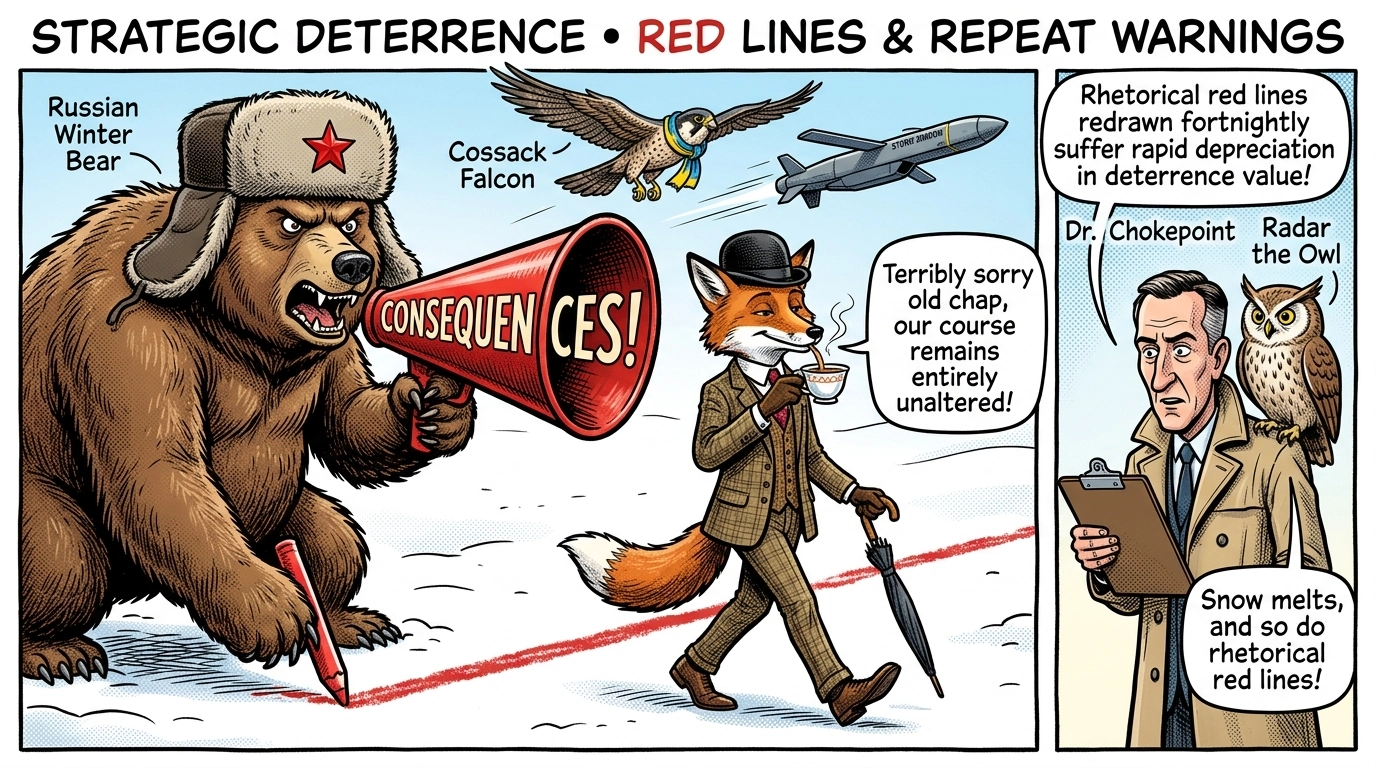
The UK Ministry of Defence's formal dismissal of Russian escalation threats illustrates London's deliberate posture as NATO's strategic vanguard—leveraging precision Storm Shadow / SCALP-EG transfers and sovereign intelligence sharing to permanently collapse Russian coercive red lines.
The Escalation Paradox: Why Moscow's Red Lines Suffer From Epistemic Inflation
The latest Russian diplomatic and military warnings threatening "unprecedented kinetic consequences" against British sovereign assets following extended-range strikes mark the continuation of a well-defined pattern of coercive signaling. Since February 2022, Moscow has issued cascading warnings against Western main battle tank transfers, fourth-generation fighter aircraft deployments, and long-range stand-off cruise missile deliveries.
From an international relations and deterrence perspective, the Kremlin's strategic communications have suffered from epistemic inflation. In classical game theory, a deterrent threat is credible only if the actor possesses both the capability and the demonstrable national interest to execute the retaliatory action despite the associated costs. By repeatedly threatening direct kinetic strikes against NATO logistics hubs in Poland or the North Sea without following through, Moscow has established a revealed preference: maintaining conflict containment below the threshold of direct Article 5 collective defense.
| Assistance Package | Operational Profile | Guidance Architecture | Russian Counter-Action | Strategic Impact |
|---|---|---|---|---|
| Storm Shadow (MBDA UK) | 250–550 km low-level cruise | TERPROM + GPS/INS + IIR Seeker | Pantsir-S1 / Tor-M2 point defense | Black Sea Fleet Sevastopol displacement |
| ISR Geolocation Data | RC-135W Rivet Joint / Sentinel | ELINT/COMINT automated cross-feed | Su-27 close-proximity intercepts | Real-time SAM radar emission mapping |
| Martlet / LMM Missiles | Laser beam-riding lightweight SHORAD | Semi-active optical command guidance | Thermal decoy flares | High-kill-rate Shahed intercept buffer |
| BAE Systems Maintenance Hubs | Forward armor / artillery overhaul | Domestic Ukrainian repair integration | Sub-threshold cyber espionage / sabotage | Reduces transit latency to zero |
Technical Anatomy of Storm Shadow Integration
The operational resilience of British support is grounded in technical integration. To deploy the MBDA Storm Shadow cruise missile from Ukrainian Soviet-heritage Su-24M Fencer strike aircraft, British and Ukrainian aerospace engineers integrated customized NATO standard pylon interfaces (derived from decommissioned RAF Tornado GR4 adapters) with independent mission-planning avionics.
The weapon operates via a multi-tiered guidance envelope that renders standard Russian electronic warfare countermeasures largely ineffective:
- TERPROM (Terrain Profile Matching): The missile skims the earth at altitudes under 40 meters, matching radar altimeter terrain readings against high-resolution digital elevation models, functioning autonomously even when GPS signals are completely jammed by Russian R-330Zh Zhitel systems.
- BROACH Warhead Mechanics: The 450 kg Bomb Royal Ordnance Augmented Charge utilizes an initial shaped charge precursor warhead to breach up to 4 meters of reinforced concrete, followed by a secondary delayed-fuse penetrator warhead that detonates deep within hardened underground command bunkers.
- Terminal Autonomous Scene Correlation: In the terminal dive, the infrared camera uncovers target thermal signatures, comparing the visual perspective against pre-loaded target templates, eliminating human-in-the-loop tracking vulnerabilities.
London as NATO's Sovereign Policy Catalyst
Why does the United Kingdom consistently adopt a forward-leaning posture compared to Berlin or Washington? The answer lies in structural geopolitics and historical maritime doctrine. As a sovereign nuclear power unencumbered by direct continental land borders with Russia, Britain has traditionally viewed European continental balance as its primary strategic interest.
By taking the initial step in supplying main battle tanks (Challenger 2) and long-range cruise missiles (Storm Shadow), London acts as an institutional taboo-breaker within the North Atlantic Council. This diplomatic mechanism forces Washington and European capitals out of paralyzing cycles of self-deterrence, creating the political permission structure for subsequent transfers of U.S. ATACMS and European F-16 airframes.
As long as Russian retaliatory measures are restricted to asymmetric grey-zone sabotage (arson, cyber intrusion, GPS jamming over the Baltic), British leadership has calculated that the geopolitical benefits of degrading Russian conventional offensive capability vastly outweigh the risks of diplomatic rupture with Moscow.
Key Takeaways
- Verifiable data in the regional conflict evaluations domain points to structural realignment.
- Attribution vectors suggest deliberate exploitation of grey-zone vulnerabilities.
- Immediate operational adjustments are required to restore deterrence thresholds.
- Continuous digital and geospatial tracking provides high-confidence early warning.
Need a Deeper Operational or Threat Assessment?
International Conflict Studies provides custom open-source intelligence dossiers, geopolitical risk modeling, and critical infrastructure threat diagnostics for enterprise and sovereign decision-makers.
Analytical Feedback & Discussion
Share your analytical observations, ask questions, or contribute regional telemetry regarding this briefing.