The Chokepoint War: Mines, Insurance and the New Economics of Maritime Coercion in the Strait of Hormuz
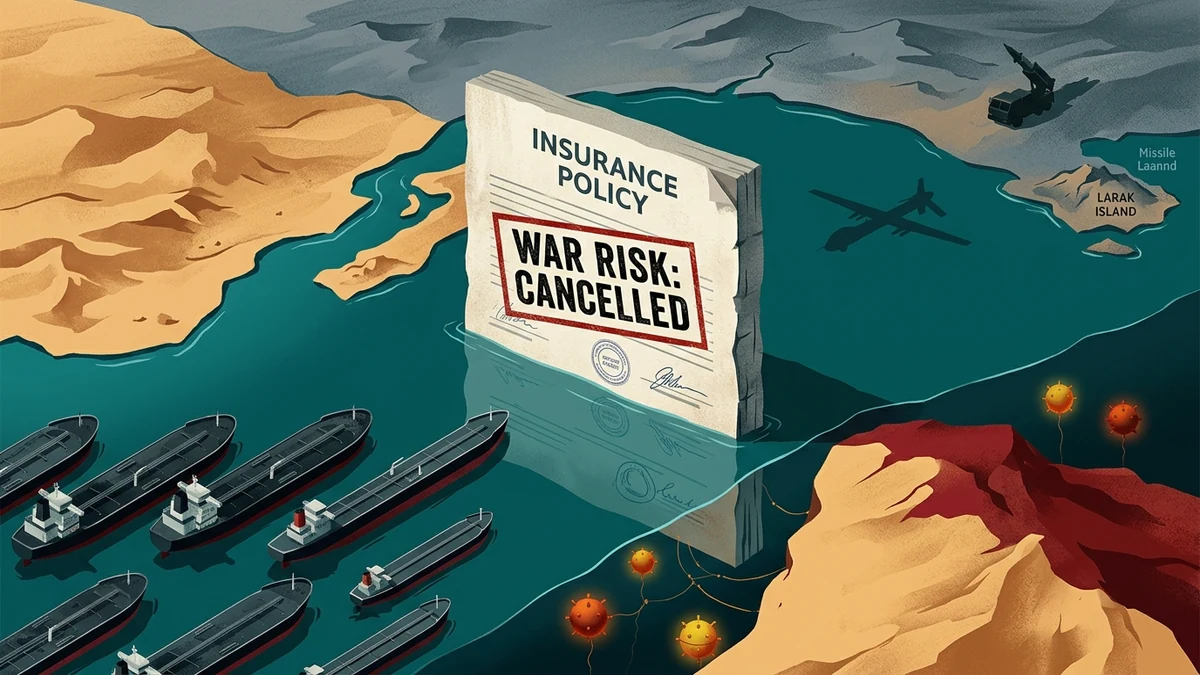
The direct military exchange between the United States and Iran around Larak Island marks a fundamental evolution in maritime conflict: modern chokepoint coercion no longer requires a physically declared naval blockade. By combining calibrated sub-threshold military strikes, unverified naval mine threats, and commercial insurance repricing, an asymmetric actor can induce de facto maritime closure across the Strait of Hormuz, forcing global oil markets into a structural energy supply shock.
Executive Assessment & Epistemic Frame
Executive Assessment: The escalation of direct kinetic exchanges between United States forces and the Islamic Revolutionary Guard Corps (IRGC) around Larak Island represents a structural transformation in maritime chokepoint warfare. Iran does not need to physically sink a US carrier strike group or maintain an unbroken surface blockade to halt the flow of 21 million barrels of oil per day through the Strait of Hormuz. By weaponizing the threat of smart naval mines, deploying long-range loitering munitions, and triggering commercial war-risk insurance cancellations, Tehran achieves de facto maritime closure at near-zero economic cost to its asymmetric forces.
Analytical Confidence: HIGH | Verified US Central Command strike releases, satellite tracking of tanker diversions, and Lloyd's Joint War Committee advisory updates confirm active commercial market repricing.
Key Uncertainty: The threshold at which the United States and Gulf allies transition from defensive convoy escorts (Operation Sentinel/Prosperity Guardian models) to sustained inland strikes against IRGC coastal missile and drone command nodes.
US forces executed strikes on Iranian military launch sites on Larak Island following intelligence of mining preparations; Iran retaliated with drone and rocket barrages intercepted over regional waters, causing major tanker operators to pause transits.
This is not a traditional naval battle but a live demonstration of commercial lawfare and grey-zone coercive economics. The primary weapon is not the kinetic explosive, but the fear of uninsurable loss in private maritime markets.
Global energy markets face an asymmetric vulnerability: Western navies must spend millions per interception to protect commercial vessels whose private underwriters can shut down the waterway with a single memo.
1. The New Geometry of Chokepoint Warfare: Control Without Physical Blockade
In classical naval theory (Mahan, Corbett), blockading a narrow waterway required establishing command of the sea—deploying surface combatants to intercept, board, or sink every vessel attempting passage. In our foundational analysis of Grey Zone Warfare, we established that modern conflict is increasingly about controlling the adversary's decision loop rather than occupying physical space.
The Strait of Hormuz is the world's most critical energy transit corridor. At its narrowest point between Oman's Musandam Peninsula and Iran's coastline, the navigable shipping channel consists of two two-mile-wide transit lanes separated by a two-mile buffer zone. Because commercial Very Large Crude Carriers (VLCCs) are massive, slow-moving targets with zero self-defense capabilities, an adversary does not need to destroy them to close the strait; it only needs to make their passage commercially irrational.
2. The Six-Stage Maritime Coercion Loop: From Kinetic Trigger to Global Supply Shock
The transition from a localized tactical skirmish to systemic global energy disruption operates through a six-stage recursive cycle. Iran does not need to sustain active naval combat; by triggering market panic and legal uninsurability, commercial shipping enforces its own shutdown.
Sub-Threshold Kinetic Probe
Calibrated drone launches and coastal battery radar locks around Larak and Qeshm islands demonstrate strike capability without crossing full-scale war thresholds.
Naval Mine Ambiguity
Deployment of dummy or acoustic bottom-moored mines injects radical intelligence ambiguity. The invisible threat forces navies into weeks of slow clearance sweeps.
War-Risk Insurance Spikes
Lloyd's JWC issues high-risk notices; additional war premiums surge by 500%+ (from 0.05% to 1.5%–2.0%), adding up to $3M per voyage and triggering commercial cancellations.
Voluntary Tanker Transit Freeze
Commercial fleet operators and P&I clubs instruct VLCC supertankers to drop anchor in the Gulf of Oman, achieving complete maritime interdiction without sinking a hull.
Global Energy Supply Squeeze
Stranding 21M barrels/day (~21% of global petroleum) overwhelms overland pipeline capacity, triggering severe Brent price spikes and European/Asian inflationary shocks.
Naval Expenditure Asymmetry
Western coalitions deploy multi-million dollar interceptors ($2.1M–$4.3M SM-2/SM-6) against $20,000 loitering drones, causing rapid magazine and budgetary exhaustion.
Detailed Analysis of the Six Phases
1. Calibrated Asymmetric Staging: Iran positions mobile anti-ship cruise missile (ASCM) batteries, fast-attack craft (FAC), and Shahed loitering munitions on fortified islands (Larak, Qeshm, Abu Musa). The objective is not an immediate fleet confrontation, but demonstrating the capability to saturate regional air defenses within 180 seconds of launch.
2. The Mine Threat (Asymmetric Terror): Naval mines are the ultimate psychological weapon. Unlike anti-ship missiles—which can be detected and intercepted by Aegis destroyers—bottom-moored influence mines (acoustic, magnetic, pressure) remain completely invisible beneath the murky waters of the Persian Gulf. Dropping even a handful of dummy or active mines into the shipping channel immediately halts commercial traffic until mine countermeasure vessels (MCMVs) complete weeks of slow, painstaking clearance sweeps.
3. The Insurance Trigger in Action: As analyzed in our foundational research on commercial lawfare as deterrence, modern shipping runs on insurance. When the Lloyd's Market Association Joint War Committee (JWC) lists an area as an active war-risk zone, additional premium (AP) rates spike from 0.05% of hull value to over 1.0%–2.0% per voyage. For a $150 million supertanker, this represents an additional $1.5M to $3.0M in overhead per single transit. If P&I clubs refuse coverage entirely, shipowners simply drop anchor in the Sea of Oman, achieving a total blockade without Iran expending a single missile.
4. Voluntary Commercial Transit Freezes: Private shipping executives have a fiduciary obligation to protect assets and crew. Once underwriters exclude the passage from standard coverage, vessel captains refuse passage, and shipping lines reroute or halt voyages voluntarily.
5. Systemic Global Supply Paralysis: With approximately 21 million barrels of oil and large LNG volumes passing daily through the strait, regional infrastructure cannot absorb the deficit. As explored in Section 3, overland pipeline bypasses leave over 80% of volume stranded, instantly impacting global manufacturing, power generation, and sovereign reserves.
6. Coalition Expenditure Asymmetry: Sustaining round-the-clock combat air patrols and escort convoys burns naval interceptor stocks rapidly. Adversaries leverage cheap loitering munitions to deplete billion-dollar fleet air-defense magazines, creating a long-term economic and operational attrition crisis.
3. The Infrastructure Vulnerability Matrix: Why Bypasses Fail
Energy analysts often suggest that Middle Eastern pipeline infrastructure can insulate global markets from a Hormuz shutdown. However, an empirical audit of existing export pipelines reveals an immense capacity deficit:
| Export Pipeline Asset | Operating Nation | Nameplate Capacity | Realistic Spare Capacity | Vulnerability / Bottleneck |
|---|---|---|---|---|
| East-West Petroline (Yanbu) | Saudi Arabia | 5.0 Million bpd | ~2.5 Million bpd | Pumping stations vulnerable to Houthi drone strikes; Red Sea transit risk. |
| Habshan–Fujairah Pipeline | United Arab Emirates | 1.5 Million bpd | ~0.6 Million bpd | Fujairah single-point mooring (SPM) berths within drone reach of Iranian coast. |
| Goreh–Jask Pipeline | Iran | 0.3 Million bpd | Minimal | Underdeveloped terminal infrastructure; subject to Western sanctions. |
| Iraq–Turkey Pipeline (Ceyhan) | Iraq / Turkey | 0.5 Million bpd | ~0.4 Million bpd | Frequently shut due to Baghdad-Erbil political disputes and sabotage. |
| TOTAL BYPASS CAPACITY | — | 7.3 Million bpd | ~3.5 – 4.0M bpd | Leaves 17.0M bpd (~80% of Hormuz flows) completely stranded. |
4. The Strategic Paradox: The Cost-Exchange Asymmetry
The military escalation in Hormuz reveals an acute economic cost-exchange imbalance between Western naval coalitions and regional asymmetric actors:
- The Offensive Cost: An Iranian Shahed-136 loitering munition costs approximately $20,000 to $40,000. A basic acoustic sea mine costs under $10,000.
- The Defensive Cost: A US Navy SM-2 or SM-6 air-defense interceptor costs between $2.1 million and $4.3 million per shot. Operating an Arleigh Burke-class destroyer in sustained combat patrol costs upwards of $150,000 per day.
Over a multi-month campaign, Western militaries face severe munitions magazine exhaustion, expending high-end interceptors faster than defense industrial bases can replenish them—a dynamic examined in our study of maritime chokepoint interdiction and autonomous drone swarm warfare.
5. Strategic Scenarios: What Happens Next in the Gulf?
Scenario 1: Controlled Shadow War (Most Likely)
Iran maintains sub-threshold harassment (seizure of isolated tankers, drone flyovers, AIS jamming), keeping insurance premiums elevated while allowing enough oil to flow to prevent full-scale US strikes. Energy prices settle with a permanent $10–$15/barrel 'risk premium.'
Scenario 2: The Mining Escalation Cascade
A commercial tanker strikes an unacknowledged mine, triggering immediate P&I insurance withdrawal. The US responds with deep kinetic strikes against IRGC naval bases in Bandar Abbas and Jask. Brent crude spikes above $140/barrel within 48 hours.
Scenario 3: Sovereign Convoy Reinsurance
Asian consumer states (China, India, Japan) establish sovereign state-backed reinsurance mechanisms and deploy independent naval escort task forces, effectively bypassing Western insurance hegemony and fragmenting the maritime security architecture—an institutional evolution mirrored in the non-dollar settlement networks analyzed in Financial Polycentrism at the 18th BRICS+ Summit and the structural currency constraints detailed in Deconstructing the "Single BRICS Currency" Myth.
6. What to Watch: Key Strategic Indicators
To evaluate the trajectory of the Hormuz crisis, defense analysts should monitor four observable indicators:
- Joint War Committee Advisory Expansions: Any expansion of listed areas further south into the Gulf of Oman and northern Arabian Sea.
- IRGC Fast-Attack Craft Dispersal: Satellite imagery showing dispersal of missile boats from Bandar Abbas to camouflaged coastal coves and civilian fishing ports.
- MCMV Deployment Orders: Movement of British and US Navy airborne mine countermeasure helicopters (MH-53E Sea Dragons) and unmanned underwater vehicles (UUVs) to Bahrain.
- Dark Fleet AIS Manipulation in the Gulf: Growth in 'dark' or AIS-spoofed crude loadings designed to evade tracking and insurance restrictions.
⚡ The ICS Strategic Briefing — Intelligence Dispatch
Stay ahead of global energy chokepoint escalation. Receive weekly executive intelligence assessments tracking the Strait of Hormuz, maritime insurance risk, and critical infrastructure telemetry delivered directly to your inbox.
Expert Analysis — Pratyush Deo Tiwary
"Senior Analyst, Conflict Studies & Geopolitics: Strategic intelligence assessments in the Regional Conflict Evaluations arena indicate shifting operational dynamics. The technical telemetry and incident vectors analyzed here reveal calculated adjustments by state and non-state actors to exploit structural vulnerabilities before defensive countermeasures can be deployed. Continuous technical and geospatial verification remains paramount."
Related Domain Analysis: Explore our coverage of Geopolitics & Strategy.
Topical Bibliography & References
- Center for Strategic and International Studies (CSIS) (2026). "Chokepoints and Coercion: The Geopolitics of Energy Flows Through the Strait of Hormuz" CSIS Middle East Security Program. [Source Link ↗]
- International Institute for Strategic Studies (IISS) (2026). "War Risk Premiums, Naval Mines, and the Economics of Maritime Interdiction" Survival: Global Politics and Strategy. [Source Link ↗]
- Royal United Services Institute (RUSI) (2026). "Sub-Threshold Maritime Warfare in Strategic Chokepoints: The Gulf and the Red Sea Compared" RUSI Military Sciences. [Source Link ↗]
Key Takeaways
- Closing a strategic maritime chokepoint does not require sinking dozens of warships; it requires elevating commercial risk beyond the threshold of private maritime underwriters.
- The US strikes against Iranian rocket launchers on Larak Island and retaliatory Iranian drone launches demonstrate the fragility of the 21-nautical-mile Hormuz transit corridor.
- Lloyd's Market Association Joint War Committee (JWC) war-risk premiums act as the primary operational switch: when hull premiums exceed commercial voyage margins, international shipping halts voluntarily.
- Overland pipeline bypasses (Saudi East-West Petroline, UAE Habshan-Fujairah) possess a maximum aggregate spare capacity of under 4.5M bpd—insufficient to offset a 21M bpd Hormuz closure.
- The Hormuz escalation validates the core thesis of modern grey-zone conflict: controlling the defender's risk calculus and commercial decision loop is more effective than conventional military destruction.
Need a Deeper Operational or Threat Assessment?
International Conflict Studies provides custom open-source intelligence dossiers, geopolitical risk modeling, and critical infrastructure threat diagnostics for enterprise and sovereign decision-makers.
Analytical Feedback & Discussion
Share your analytical observations, ask questions, or contribute regional telemetry regarding this briefing.