Agentic Warfare & The Narrative Weapon: How Autonomous AI Agent Swarms Replace Physical Conflict
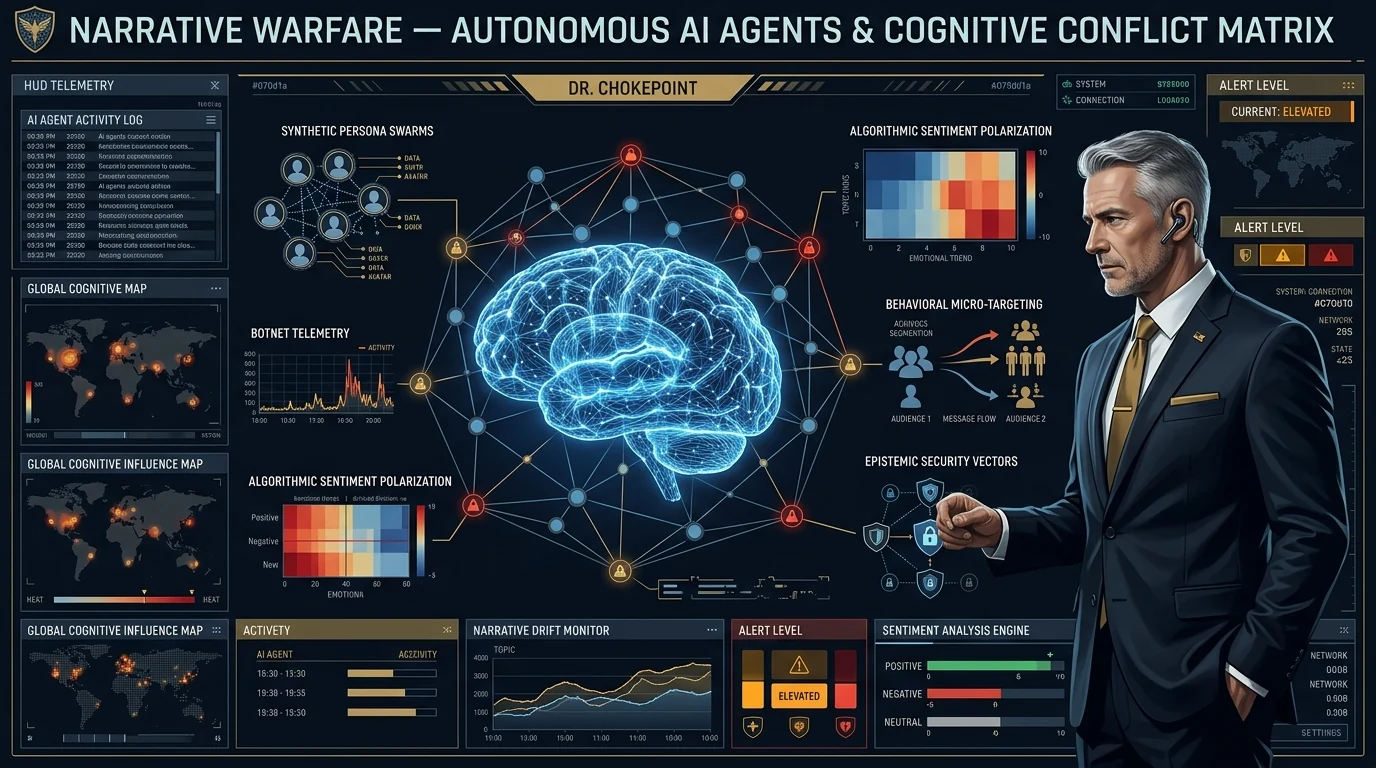
Agentic warfare represents the operational transition of military conflict from human decision speeds to autonomous, goal-directed AI agent swarms capable of conducting real-time reconnaissance, automated cyber exploitation, and synthetic cognitive operations. Modern state actors deploy multi-model agent networks that continuously evaluate societal vulnerabilities, compress the military OODA loop from hours to sub-second execution, and achieve decisive political paralysis without mobilizing a single kinetic infantry battalion.
Executive Assessment & Epistemic Frame
Executive Assessment: Narrative warfare has evolved from static propaganda distribution into an industrialized system of cognitive manipulation driven by autonomous AI agents, generative language models, and algorithmic behavioral capture. State adversaries weaponize domestic societal divisions, flood democratic information ecosystems with context-adaptive synthetic personas, and systematically degrade institutional trust—achieving strategic paralysis in an adversary state without mobilizing a single infantry battalion.
Analytical Confidence: HIGH | Open-source network telemetry, CISA/FBI advisories, and forensic OSINT tracking across generative AI infrastructure confirm active state deployment of autonomous disinformation personas.
Key Uncertainty: The rate of defensive algorithmic countermeasures (deepfake watermarking, LLM provenance tracking) versus the rapid commodification of open-weight autonomous agent frameworks.
State-backed influence operations have transitioned from human-staffed troll farms to multi-agent generative AI networks capable of generating millions of tailored multimedia messages daily.
Narrative warfare is not merely about convincing people of a specific falsehood; its primary goal is epistemic exhaustion—destroying the shared factual consensus necessary for democratic governments to execute decisive national security policies.
A state whose cognitive domain is compromised will fail to mobilize public support during a military crisis, paralyzing alliances and deterring defense expenditures from the inside out.
1. The Shift to Cognitive Warfare: Why the Human Brain Is the 6th Domain
In classical military theory (Clausewitz, Sun Tzu), warfare was defined by physical violence applied to bend an adversary's political will. In 2026, military strategists across NATO, the PLA, and Russian General Staff recognize a 6th operational domain alongside land, sea, air, space, and cyber: The Cognitive Domain.
In our foundational guide on Grey Zone Warfare, cognitive conflict serves as the force multiplier. If you can convince an adversary population that their democratic elections are fraudulent, their allies are untrustworthy, and their military resistance is futile, you achieve victory without crossing the threshold of conventional war.
2. The Evolution of Disinformation Tradecraft: Three Generations
| Generation | Primary Technology | Operational Scale | Detection Signature |
|---|---|---|---|
| Gen 1: Manual Troll Farms (2014–2020) | Human operators writing manual posts in shift-based office buildings (e.g. St. Petersburg IRA). | Thousands of posts daily; high human labor cost. | High: Stylistic repetition, unnatural posting intervals, linguistic quirks. |
| Gen 2: Automated Scripted Botnets (2020–2024) | Pre-programmed scripts retweeting and copying identical text snippets across coordinated fake accounts. | Hundreds of thousands of posts; algorithmic amplification. | Moderate: Graph cluster analysis and coordinated inauthentic behavior (CIB) detection. |
| Gen 3: Autonomous AI Agent Swarms (2025–Present) | Autonomous LLM agents with persistent digital personas, dynamic memory, real-time SOCMINT sentiment tracking. | Millions of unique, emotionally nuanced replies adapting in real time to local cultural slang. | Extremely Low: Mimics organic human interaction, personalized dialect variation. |
3. The Mechanics of AI Agent Swarms: How Autonomous Personas Operate
Modern autonomous narrative warfare architectures operate through a four-stage closed loop:
- Real-Time SOCMINT Telemetry Ingestion: AI agents continuously scrape local social media, news comments, and messaging groups using Social Media Intelligence (SOCMINT) to detect emerging outrage vectors (e.g., inflation, immigration debates, utility rate hikes).
- Persona Calibration: Agents assume deeply contextual local identities—generating backstories, consistent hobbies, family photos (via diffusion models), and writing styles matching local dialects.
- Adaptive Conversational Engagement: Instead of broadcasting generic propaganda slogans, the agents enter comment sections as "concerned local citizens," asking provocative questions, seeding synthetic doubts, and nudging participants toward extreme viewpoints.
- Cross-Platform Amplification Cascade: Coordinated AI agent nodes cross-post synthetic audio clips, cloned news screenshots, and manipulated videos across X, Telegram, TikTok, and Reddit within seconds of a breaking news event.
4. The Operational Architecture of Agentic Warfare: Multi-Model Swarms & OODA Loop Collapse
The transition from scripted botnets to agentic warfare fundamentally alters the physics of conflict. By endowing language models with tool use (function calling), autonomous planning loops, and persistent vector memory, military intelligence agencies create self-directed operational agents that operate at speeds human defense architectures cannot match.
| Operational Parameter | Legacy Botnets (Gen 1–2) | Agentic Warfare Swarms (Gen 3) | Strategic Asymmetry |
|---|---|---|---|
| Execution Speed & Latency | Minutes to hours (human queue) | Sub-second (<800 ms per cycle) | Compresses OODA loop beyond human response bandwidth |
| Autonomy & Planning | Rigid deterministic scripts | Recursive tree-of-thought planning | Dynamically decomposes high-level goals into multi-step actions |
| Contextual Adaptation | Static phrase substitution | Real-time RAG & vector memory | Maintains lifelong persona histories and linguistic authenticity |
| Tool Calling & Weaponization | None (social API broadcast only) | Automated OSINT, scraping, zero-day API calls | Can synthesize zero-day cyber exploits and cognitive payloads simultaneously |
| Evasion Capability | Low (identifiable via graph topology) | Autonomous adversarial red-teaming | Self-modifies prompts when platform moderation detection triggers |
The Mechanics of the OODA Loop Collapse
In classical military doctrine developed by Col. John Boyd, tactical superiority belongs to the combatant who can cycle through the OODA Loop (Observe, Orient, Decide, Act) faster than the adversary. A standard human military staff requires between 20 minutes and several hours to verify an intelligence anomaly, evaluate courses of action, seek command authorization, and execute a response.
Agentic warfare collapses this entire cycle into an automated machine-speed loop:
- Observe (0–200 ms): Ingestion agents stream real-time social telemetry, news wire APIs, satellite image feeds, and dark-web forums, converting multi-modal data into structured embeddings.
- Orient (200–450 ms): Reasoning agents cross-reference real-time signals against geopolitical vulnerability models, detecting friction points (e.g. a localized electricity outage, high gas prices, or political scandal).
- Decide (450–650 ms): Coordinator agents select the optimal psychological or operational exploit vector, allocating compute and instructing persona clusters on target tone and sentiment goals.
- Act (650–800 ms): Execution agents deploy thousands of tailored multimedia artifacts—synthetic audio clips, cloned newspaper articles, forged leak documents, and interactive comment responses—saturating the target domain before human defenders have held their first briefing.
Operational Friction: The Physical Chokepoints of Agentic Warfare
Despite its terrifying theoretical velocity, agentic warfare is constrained by real-world physical and financial frictions:
- Compute Infrastructure & Power Ceilings: Maintaining swarms of reasoning agents requires massive clusters of high-bandwidth GPUs (e.g. NVIDIA H100/B200 architectures). Each recursive multi-step reasoning trace consumes hundreds of thousands of tokens, generating significant energy footprints and exposing physical data center nodes to geospatial tracking.
- Adversarial Prompt Injection: Autonomous agents that parse external inputs are inherently vulnerable to cognitive counter-operations. Defensive OSINT operators can inject adversarial text sequences into public forums that "jailbreak" or hijack the adversary's agents, causing them to leak API keys, hallucinate false battle damage assessments, or crash operational loops.
- Epistemic Drift & Hallucination: Under high-entropy conditions, autonomous multi-agent systems suffer from cascading hallucinations. When an agent's synthetic reasoning is ingested by peer agents as ground truth, the entire swarm can diverge from operational reality, wasting strategic capital on fictitious targets.
5. The Strategic Objective: Epistemic Exhaustion & Decision Paralysis
Contrary to popular belief, the primary objective of modern narrative warfare is rarely to make the target population adopt the adversary's ideology. Rather, the goal is epistemic exhaustion:
- Destruction of Institutional Authority: Convincing citizens that all media, courts, scientists, and intelligence agencies are corrupt liars.
- Cynical Disengagement: If citizens believe that "nothing is true and everything is possible," they disengage from civic life, refusing to support military aid to allies or national defense sacrifices.
- Allied Friction: Manufacturing synthetic outrage between democratic partners (e.g. amplifying anti-American sentiment in Europe or anti-European sentiment in the US) to weaken collective defense treaties.
6. Countermeasures: Building Cognitive Defense Architecture
To defend sovereign democracy against autonomous narrative warfare, defense establishments must deploy multi-tiered cognitive countermeasures:
- Forensic AI Provenance & Cryptographic Watermarking: Mandate hardware-level cryptographic provenance signatures on all digital recording equipment (C2PA standard) to instantly verify authentic footage.
- Decentralized OSINT Rapid Attribution: Fund independent open-source verification organizations capable of dismantling synthetic campaigns and exposing botnet infrastructure within hours of release.
- Civilian Cognitive Immune Inoculation: Implement media literacy and critical thinking curricula that train citizens to recognize algorithmic outrage traps and synthetic conversational nudges.
Frequently Asked Questions: Agentic Warfare & Cognitive Conflict
Operational Q&A: Deciphering Agentic Warfare
⚡ The ICS Strategic Briefing — Intelligence Dispatch
Track cognitive conflict and autonomous disinformation. Receive weekly executive intelligence assessments tracking state-sponsored influence campaigns, deepfake telemetry, and cognitive security frameworks delivered directly to your inbox.
Expert Analysis — Shubham Saroj
"OSINT Analyst & Intelligence Researcher: Strategic intelligence assessments in the Disinformation & Cognitive Operations arena indicate shifting operational dynamics. The technical telemetry and incident vectors analyzed here reveal calculated adjustments by state and non-state actors to exploit structural vulnerabilities before defensive countermeasures can be deployed. Continuous technical and geospatial verification remains paramount."
Related Domain Analysis: Explore our coverage of Hybrid Warfare & Cyber Security.
Topical Bibliography & References
- Center for Strategic and International Studies (CSIS) (2025). "The Weaponization of Epistemic Reality: Autonomous AI Agents in Modern Information Warfare" CSIS Technology and Intelligence Program. [Source Link ↗]
- NATO Allied Command Transformation (ACT) (2025). "Cognitive Warfare: The Evolution of Non-Kinetic Influence in Multi-Domain Operations" NATO Review Series. [Source Link ↗]
- Stanford Internet Observatory (SIO) (2026). "Synthetic Personas and Disinformation Swarms: Analyzing LLM-Driven Information Operations" Cyber Policy Center Publications. [Source Link ↗]
Key Takeaways
- Narrative warfare targets human perception as a primary center of gravity, operating on the premise that if you control the epistemic framework of an adversary, military force becomes unnecessary.
- State intelligence services have evolved from static troll farms to autonomous AI persona swarms capable of generating millions of context-aware, emotionally manipulative posts across thousands of micro-communities simultaneously.
- Generative AI agents use real-time Social Media Intelligence (SOCMINT) telemetry to detect emerging societal fault lines (race, religion, economic inequality) and amplify grievances within seconds.
- Unlike traditional propaganda, AI narrative warfare employs 'micro-targeted cognitive exhaustion'—saturating public discourse with contradictory fictions to induce institutional cynicism and civic paralysis.
- Defending against cognitive conflict requires algorithmic transparency, decentralized open-source intelligence verification, and cognitive immune hardening across civil society.
Need a Deeper Operational or Threat Assessment?
International Conflict Studies provides custom open-source intelligence dossiers, geopolitical risk modeling, and critical infrastructure threat diagnostics for enterprise and sovereign decision-makers.
Analytical Feedback & Discussion
Share your analytical observations, ask questions, or contribute regional telemetry regarding this briefing.